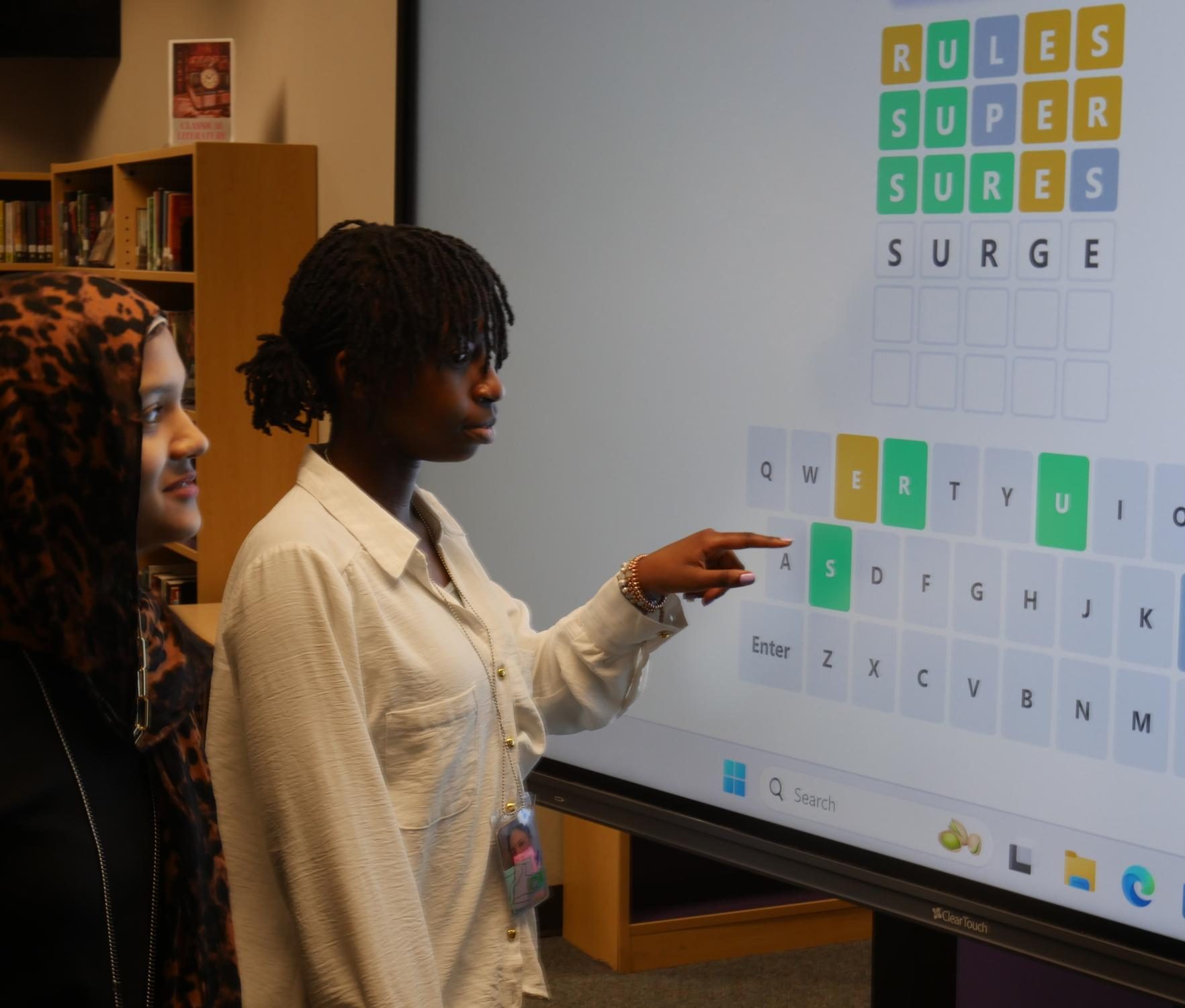
 eep in the library, surrounded by books filled with words that make up thousands of stories, at a Smartboard, freshman Gloria Lushanga contemplates blank Wordle tiles and places her first word: R U L E S. She notices most of her vowels are either in yellow or green. So, she immediately fills in the second row with the word: S U P E R. Observing that the two green letters are in their correct place, she types her third word: S U R E S. She moves closer to the board and types and deletes new letters into the fourth row. Then, freshman Safiyah Khan looks over Lushanga’s shoulder and suggests the next word: S U R G E. Lushanga is delighted and thanks Khan.
 osh Wardle, a software engineer, created a prototype for a word game named in a punning variation of his own name in 2013, but didn’t publish it. In October 2021, he and his partner, Palak Shah, developed and published the familiar version played today. Wordle blew up, with thousands of players daily around the world, and was soon acquired by The New York Times. This acquisition, along with the need for COVID-era at-home entertainment, brought the game to a global audience.
“It was during the pandemic or around the pandemic, ” Librarian Julie Fitzegrald said. “It was something to do, and everyone was kind of doing it. I followed the trend. And I like word games.”
 ts widespread popularity during the pandemic transferred over to social media, introducing more people to the game.
“I was bored, and people online, like Twitter and Facebook, just kept posting green squares, and I had nothing else to do,” Library paraprofessional Stephen Andrews said.
 he internet connects millions every day, and Wordle is just another way people can connect with one another.
“I started playing Wordle ’cause my older siblings got into it,” junior Lena Nguyen said. “Discord had a Wordle thing where you can compete with your friends in them. I think my friend, [junior] Tyler Nguyen, and I started doing that, and then we started playing Wordle Unlimited.”
 hen guessing the daily Wordle, whether solo or with a team, some students have strategies for choosing their starting word for the first row.
“Well, usually, for my first word, I use something that has a lot of vowels,” junior Natalie Nguyen said. “So, I use

the word ‘F-A-I-R-Y’ all the time, but if it doesn’t have anything, usually it does have one of those vowels.”
 er second choice is a less-common word.“Which is S-A-L-E-T, has an E in it, which is usually in most words,”
to deduce the useful letters.
Another student uses the same strategy with a different word.
“Those would be A-D-I-E-U, like to bid somebody adieu, or A-U-D-I-O,” Lena said. “Usually it’s those two because they happen to weed out a lot of vowels.” Depending on which word she starts with, her second starting word is storm or stern since adieu doesn’t contain the letter “o” and audio doesn’t contain the letter “e”.
 heir tactics, which provide them shortcuts to guessing the daily Wordle, aid their success. What began as a simple, small game has turned into a way for friends to connect.
“It connected me with my peers and friends because it’s something that we often do together…we race to see who can get the word first,” freshman Leonardo Aguirre said.
 e said he felt closer to the people around him while playing Wordle with them.
“Andrews and I discuss Wordle quite a bit when we’re, you know, talking about the previous day’s Wordle,” Fitzgerald said.
 long with these strategies, the advantages of connecting with people, the magnetic pull towards guessing the daily Wordle, are no surprise.

“There are so many 5-letter words that are possible. I guess maybe, no one really thought about how many there were that you could guess and what could be a word but isn’t a word,” Fitzgerald said.
 reshman Ethan Garcia also enjoyed the connection of playing as an alternative to phones.
“My friend, [freshman] Santiago Martinez, and I play it in the library,” he said. We play it because there aren’t many games to play. Phones are banned, and everything’s on technology nowadays. But, we’re just playing for fun, for humor, and entertainment.”
 ome scientific research backs up the benefits of Wordle.
According to a recent study by the University of Muhammadiyah Makassar in Indonesia, 40 students were observed and grouped into those who played Wordle and others who didn’t. Afterwards, the researchers saw that those who used the game performed better than those who learned using traditional methods.
“A study conducted showed that regular word game players tend to have a 15% larger vocabulary compared to non-players,” researchers in the Linguistic Journal said.
 his data and real-life anecdotes show that Wordle can improve vocabulary. Researchers explained that learning new words through games makes students more engaged and motivated.
“Mr. Andrews indicated that [students]like to play Wordle and Connections, so I just kept up with that tradition,” Fitzgerald said. “Y’all make very good, educated guesses, and it’s fun to play with you when you are stuck… because I’d prefer you figure it out on your own. It’s just such a small moment in the day, but it’s a nice little bonding activity too.”